In the early days, author Raye Ringholz once wrote, the Snyderville Basin was so beautiful that they called it a park.
“Unharnessed trout creeks gushed from snowpack down to a glossy meadow alive with kingfishers, prairie falcons, grouse, and sandhill cranes nesting among the willows and native grasses,” Ringolz waxed poetic in a 1995 article for Park City Lodestar magazine.
When pioneer explorer Parley P. Pratt ventured into the basin in the summer of 1848, he described it as “a beautiful meadow or park … comprising some three or four thousand acres of excellent land, clothed with grass and interspersed with wild flax and strawberry vines.”
But Pratt had an agenda. “Altogether it was the most desirable and convenient place for stock farms I ever saw,” he continued, “plentiful in grass, watered as Eden and sufficiently timbered to supply hundreds of families.”
And the families came.
“The forests shrank,” Ringholz wrote, “the bottomlands became grainfields and pastures for cattle, and a wood-and-brick town filled the mouth of the canyon.” The settlers built fences, roads and railroad tracks, drained wetlands, and turned pristine creeks into irrigation ditches.
About a century later, in 1957, Salt Lake City businessman Leland S. Swaner bought 990 acres of bottomlands and adjacent hillsides around Kimball Junction and named it the Spring Creek Black Angus Ranch. A few years later the construction of Interstate 80 slashed through his property.
In 1978, with the local population booming, Swaner applied for a zone change to build a subdivision, Spring Creek, on a portion of his remaining land north of I-80. “What we generally have in mind doing is developing the land we can’t ranch,” he told The Park Record. Other developments sprang up around the basin.
“Houses and condominiums intruded on the hilltops, clung to the mountainsides, clustered in the ravines and crept, subdivision by subdivision, into the valley meadows, threatening the last vestiges of a park,” Ringholz wrote.
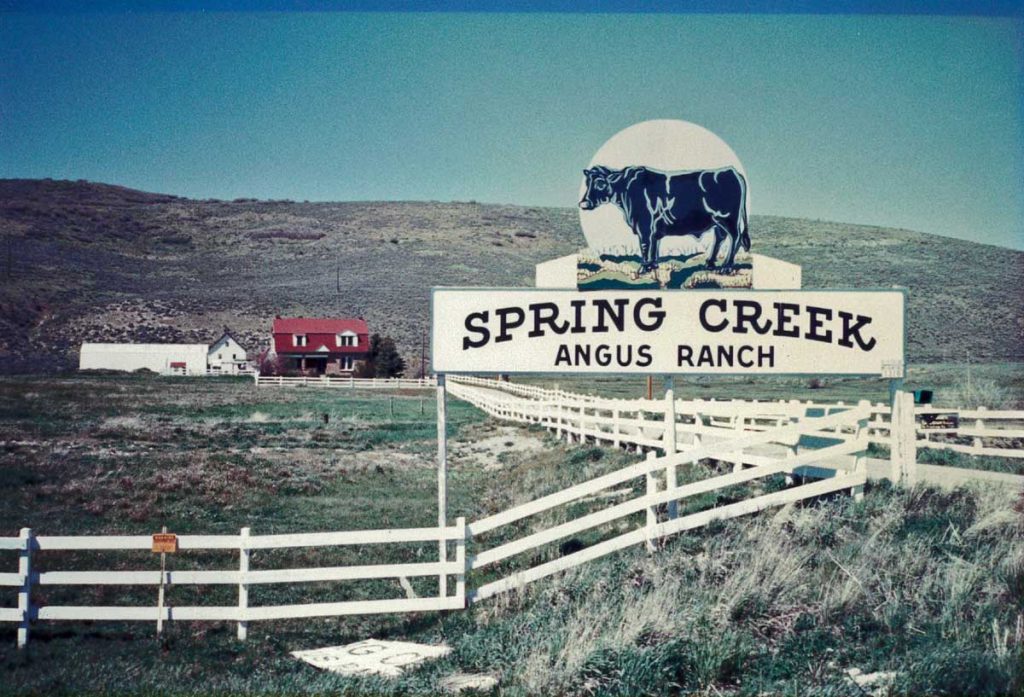
Credit: Courtesy of the Swaner Family.
By 1989, local residents were becoming alarmed. Led by Myles Rademan, Park City’s public affairs director, they met in living rooms around the city and surrounding neighborhoods. They shared one concern: the need to preserve open space.
“We all realized it’s going to disappear very fast here,” Park Meadows resident Chuck Klingenstein told Ringholz.
In 1990, Klingenstein and others banded together to form the Summit Land Trust Association, which later became the Utah Open Lands Conservation Association, with Wendy Fisher as its executive director. The group started working on conservation projects as far away as Southern Utah. Then came the chance to focus its energy on an important project closer to home.
When Spring Creek developer Leland Swaner died in September 1992 after a remarkable career as a businessman and public servant, his wife, Paula, started looking for ways to honor him. “Mom wanted to do something in his memory – a preservation of some kind,” her son, landscape architect Sumner Swaner, said in 1993.
Sumner, who had worked as a ranch hand on the property as a teenager, suggested they consider conserving a 190-acre portion of the Black Angus Ranch near Kimball Junction where his father had once envisioned building about 300 homes.
“Leland had always been a determined property-rights advocate and … had questioned the practicality of donating land for conservation easements,” Ringholz wrote. “Sumner was convinced otherwise.”
By this time Summit County was requiring developers to set aside a percentage of their projects as open space. Typically, this meant creating a landscaped common area inside each development. But Sumner proposed that the Swaner family band together with other Snyderville-area developers and Utah Open Lands to create several hundred acres of common area, protected by conservation easements, adjoining their properties.
But this wouldn’t be your garden-variety park. Sumner envisioned restoring the land as much as possible to its natural state, much of it wetlands in the years before Parley P. Pratt spread the gospel to legions of newcomers.
“The environmental design background of Sumner Swaner … was crucial to seeing the wetland values as a whole instead of parts of individual properties,” Wendy Fisher of Utah Open Lands wrote in a 1996 guest editorial in The Park Record. “Additionally, in memory of her late husband, Paula Swaner recognized the value of donating her property within the Basin, foregoing tremendous development potential.”
It was an ambitious plan. Sumner Swaner and Wendy Fisher still had to win the trust of surrounding property owners, Summit County politicians, federal agencies and the general public.
Look for the rest of the story in next Wednesday’s Park Record.
We still have a few tickets for the Glenwood Cemetery Tribute Event scheduled for Saturday, October 11 in the afternoon timeslot! For an afternoon ticket, go here. If you have any questions, please contact Diane Knispel at education@parkcityhistory.org or 435-574-9554.