Welcome back to our second article in an occasional series discussing the evolution of Park City from a “Ghost Town” to an internationally acclaimed resort destination. Our first installment explored the town’s dire circumstances in the early 1960s. These included, but were not limited to chronic unemployment, a continuing exodus of residents, removal from an updated map of Summit County (in 1959), and “Ghost Town” classification in two reference books. A designation scorned by all remaining “Parkites”.
The town’s dominant employer (United Park City Mines, aka UPCM), its residents, and a who’s who of prominent politicians and business leaders would unite in a campaign to banish the malevolent economic spirits. Before any of this occurred, for the first time in years, fate ever so subtly but profoundly tipped the scales in Park City’s favor. A chance meeting between two strangers would spark a friendship. Neither of them would ever be the same – nor Park City.
The junior Senator from Massachusetts was on a roll. In 1956 he narrowly lost the Democratic Party nomination for VP. Political power brokers took notice. He was 39 years old. A Pulitzer Prize followed in 1957 for his book “Profiles in Courage”. In 1958 he was re-elected to the US Senate in a landslide. Subsequently, a higher calling beckoned – the 1960 presidential race.
John F. Kennedy (JFK) traveled extensively to secure enough Democratic delegates to win his party’s nomination. This process included befriending, wherever possible, members of the press and media. In 1959 JFK embarked on a tour of western states, including Utah. Kennedy’s handlers arranged for John Fitzpatrick, then publisher of the Salt Lake Tribune to host the aspiring presidential candidate. Fate intervened, as Fitzpatrick faced an irreconcilable schedule conflict. Without hesitation he asked Jack Gallivan, his Tribune colleague to perform the honors.
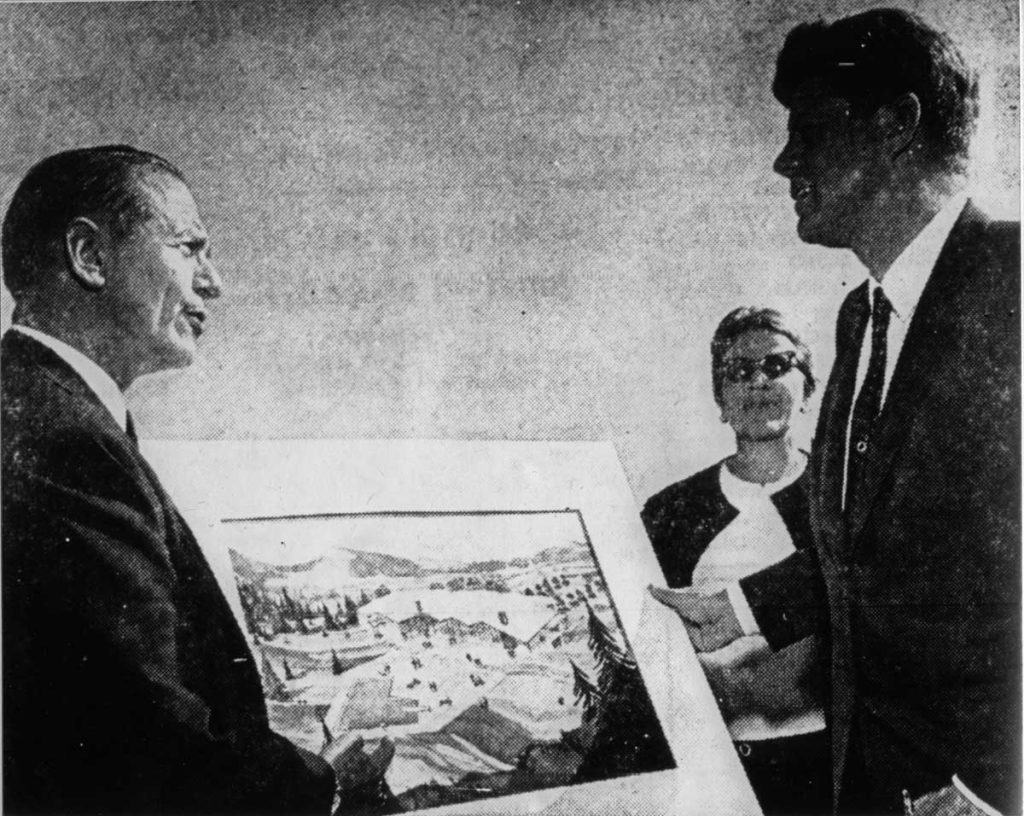
Credit: Park City Historical Society & Museum, Park City Mountain Resort Collection
Jack Gallivan was a Parkite to his soul. He was born in Park City and his father, Dan, worked for the Daly West Mine. By 1959 Jack was a senior executive at the Tribune. Senator Kennedy and Jack developed an instant friendship. Their initial meeting revealed shared passions: faith (both were Catholic), journalism, a desire to help others, and a commitment to country. Jack would advise Kennedy on his 1960 Presidential campaign. Their friendship continued after JFK narrowly defeated Richard Nixon to become the 35th President.
One of the new administration’s signature programs was the ARA, the Area Redevelopment Administration. This program budgeted $400 million to invest in chronically depressed regions. Park City qualified. To diversify the town’s economy and create employment opportunities, UPCM proposed building a ski resort. To do so, they established the Park City Land and Recreation Development Company. They petitioned the ARA for a 25-year low interest loan (4%) to fund design and construction.
On August 10, 1962, during a meeting at the White House with Kennedy, Jack inquired about the loan, which had gone unapproved or unanswered for months. The president’s press secretary, Pierre Salinger, was tasked to follow up. Before August ended, the funds ($1.2M) were approved. UPCM matched the Federal contribution. Development of the new resort commenced. The ribbon cutting ceremony occurred on December 21, 1963. Treasure Mountains resort opened to rave reviews. Unfortunately, President Kennedy was unable to attend.
Acknowledgements: Thank you to Jack “Champ” Gallivan and Larry Warren for their contributions to this article.