This article concludes our brief history of the Swaner preserve.
Not long ago, Rhea Cone, director of conservation at the Swaner Nature Preserve and EcoCenter, was visited by two men who had camped on the land in the early 1990s as participants in a Boy Scout Jamboree.
“They called it a dust bowl,” she said. “But I think that that dustbowl of the early ’90s … today would be too wet to camp in for a lot of the year.”
In the 32 years since the Swaner family set out to restore 190 acres of their ranchland near Kimball Junction to their natural state, a remarkable transformation has been taking place. Those 190 acres have become 1,200. Streams have returned to their original meandering channels. Willows sprout along their banks. Birdwatchers have spotted more than 170 species, from American kestrels to mountain bluebirds. Elk, mule deer, beavers, red foxes, bobcats, jackrabbits and numerous smaller mammals call the preserve home for at least part of the year.
In May 1993, landscape architect Sumner Swaner unveiled a plan to create a nature preserve in honor of his late father, Leland S. Swaner, by combining 190 acres of his family’s ranchland south of Interstate 80 with about 400 acres contributed by other developers including Mike Milner of Ranch Place Associates, Jim Lewis of Double M Investments (Mountain Meadows), and the Jack Jarman family (developers of the original K-Mart parcel at Kimball Junction). Those donations would help them meet the open-space requirements that Summit County had imposed on all developers of major projects in the Snyderville Basin.
It was a bold proposal. Summit County commissioners had to be persuaded that the taxpayers wouldn’t be responsible for maintaining the preserve. The Army Corps of Engineers had to approve any wetland mitigation. Eventually, Summit County agreed to a plan calling for the newly created Swaner Memorial Park Foundation to hold the title to the land and for Utah Open Lands to hold the protective conservation easements (which guaranteed that the land would never be developed). Groundbreaking for the new Leland S. Swaner Memorial Park took place on June 22, 1994.
The Swaner family expanded the boundaries of the park in 1998 by donating more than 300 acres on the north side of I-80. In 2003, the purchase of the Wallin Farm added another 107 acres east of SR 224. All told, it eventually involved about 30 individual parcels. The whole area is known today as the Swaner Nature Preserve. It covers about 1,200 acres: 350 acres north of I-80 and 850 acres south of I-80 and east of SR 224.
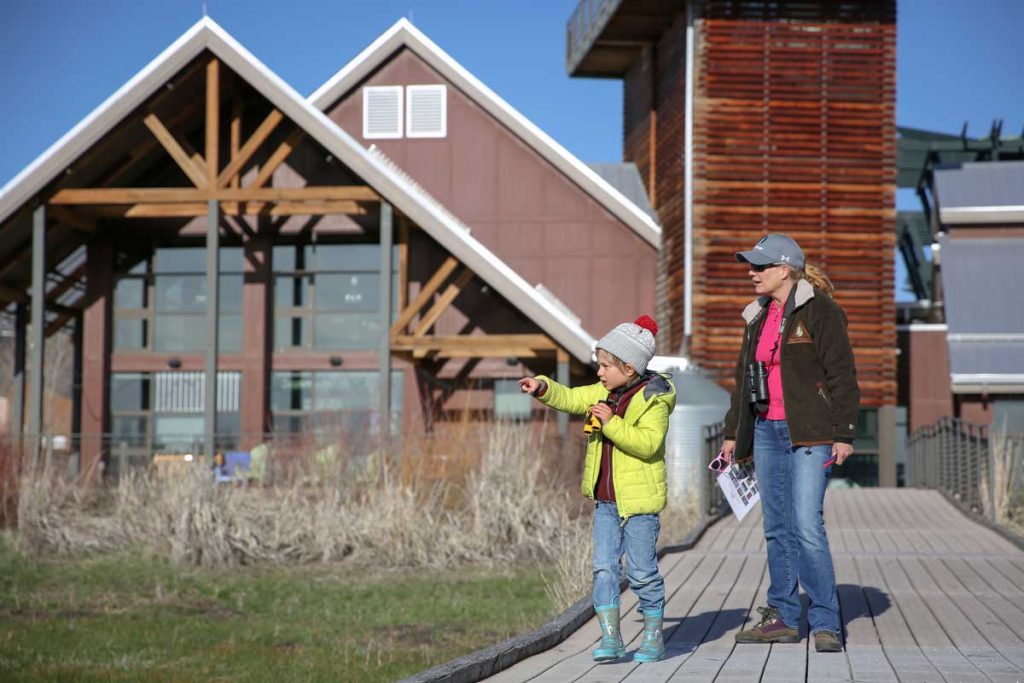
Credit: Park Record photo by Tanzi Propst.
In 2010 the Swaner Preserve donated itself to Utah State University, providing expertise and stability to the organization and an open-air laboratory for USU students in a variety of fields.
At least 550 acres of the preserve were once high-quality wetlands, according to the federal Natural Resources Conservation Service (NRCS). That was before European settlers drained the “swamps,” turned streams into irrigation ditches, cut down trees, and introduced cattle and sheep.
“Because the water table … had been drained, a lot of that historic vegetation died off,” noted Rhea Cone. “The willows couldn’t reach water. They got eaten by cows. They got trampled. … It truly was a dustbowl in many places.”
Reversing 150 years of abuse has meant an enormous effort involving consulting groups, government agencies, private organizations, preserve staff, numerous volunteers, and many donors. And it’s still going on.
According to Cone, the initial restoration work included filling in six miles of ditches, digging out over ten miles of historic stream channels, and creating some of the ponds on the preserve.
More recently, volunteers have installed almost 100 beaver dam “analogs” – manmade dams designed to mimic the work of beavers – to encourage the streams to spread out and replenish the wetlands. Meanwhile, other groups have been installing bird boxes, pulling invasive weeds, and planting dogwoods, cottonwoods, shrubs, and native grasses.
Among the streams is Spring Creek, which flows from south to north through preserve and joins East Canyon Creek on the north side of I-80. Volunteers have planted thousands of willows along the banks of both creeks to stem erosion and provide shade for struggling fish populations.
“Historically, East Canyon Creek especially was a blue-ribbon fishery – which is a designation by the state – and had big Bonneville cutthroat trout,” Cone said. However, by the year 2000 it had been included on the Environmental Protection Agency’s list of impaired water bodies.
Although their efforts have improved the quality of water leaving the preserve, the water table continues to feel the impact of explosive growth in the surrounding area, which has added unwanted nutrients, warmed the water, disrupted fish movements, and diverted creek flows for recreation.
Impressive and historic though it is, the Swaner Preserve is a small piece of a very large and ongoing puzzle.
Keep an eye out for Park City Museum events at parkcityhistory.org. And be sure to support us in a few weeks for Live PC Give PC!