Welcome back to our second and final chapter regarding the fate of the Union Pacific rail lines in Park City. Chapter 1 discussed a calamitous event that compelled the Union Pacific Railroad (UP) to either sell or abandon its 30-mile Park City rail line. Their asking price: $1.7M ($9M today). This included 33 miles of rail infrastructure and a “right-of-way” comprising 400 acres. Besides Park City – Coalville, Hoytsville, Wanship, and Keetley would also lose rail service.
By 1965, approximately 90% of the car loadings on the branch originated at a phosphate reload facility located at the southeastern end of Richardson Flat Road. In January 1986 Chevron Chemical, owner of the reload operation, announced that they would close the plant in August. The counties of Summit, Wasatch, and Utah rallied to preserve the line. They formed the Tri-County Rail Commission with a goal to purchase the line and form a new railroad company.
The Tri-County Railroad would promote both tourism and industrial development. The Mountain Lands Association of Governments, UDOT, the State Legislature, and noted politicians including Governor Bangerter and Senators “Jake” Garn and Orrin Hatch endorsed the concept. Ambitious plans followed, including the creation of a 67-mile railroad connecting Echo, Park City, Heber City, Sundance, Provo, and all towns in between. The estimated cost was projected at $15M ($44M today). The Commission began looking for funding.
Despite 111 years of serving Park City, UP held no nostalgic attachment to this branch. Clyde Durham, one of UP’s executives assigned to the project, expressed the company’s position: either raise the money or the line would be sold for salvage and abandoned.
Credit: Courtesy of Stuart Stanek.
In 1986 Brad Olch was elected to the first of his three terms as Park City’s Mayor. Coincidentally, Myles Rademan accepted Park City’s offer to manage their Planning Department. Both gentlemen would display brilliance serving their beloved community. They understood the financial challenges confronting the Tri-County Rail Commission. With or without a new railroad, Mayor Olch and his team were adamant – “we need to save this.” Myles researched salvation options.
In 1983 Congress amended the National Trails System Act to protect inactive railroad transportation corridors from abandonment. The concept was called “railbanking.” For reasons similar to Park City, in 1985 UP ended service on their twenty-mile spur serving Bellevue, Hailey, Ketchum, and Sun Valley in Idaho. In 1987 the communities submitted a bid to preserve the corridor under the Federal railbanking program. Their proposal was accepted and the Wood River Trail became a reality. Myles inquired about the process to railbank this UP line.
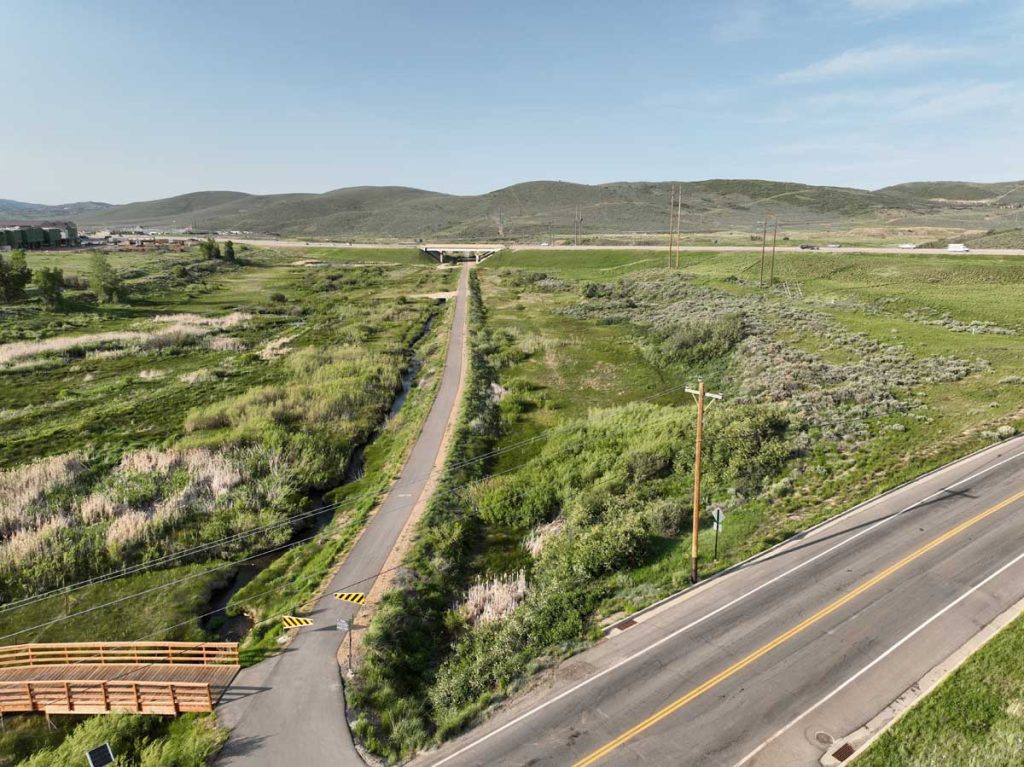
By the fall of 1988 it became evident that the Tri-County Rail Commission was unable to secure the required funding. Predictably, UP declared that the line would be abandoned in 1989. Based upon his research, Myles took the lead to protect the rail corridor. Working with the Rails to Trails Conservancy, Park City submitted an application to preserve the right-of-way. In 1992 UP’s Park City line was saved, becoming Utah’s first rail trail.
Acknowledgements: Merill Byran, Marianne Cone, Craig Drury, Sally Elliott, Jennifer Harrington, Craig Lacey, Brad Olch, and Myles Rademan.