Jordanelle Reservoir, lying just east of Park City, is a popular local destination, offering Parkites the opportunity to engage in watersports and fishing during the warmer months, and providing drinking water for those downstream from the Jordanelle Dam. Younger residents of Summit County might be surprised to learn that the dam is a relatively recent construction, having only been completed in 1993. This makes it much newer than many of the other dams in the area; Mountain Dell Dam, in Parleys Canyon, was completed in 1925 and Wanship Dam was finished in 1957.[i] The Jordanelle’s comparative newness, however, belies a long history.
Although construction of the Jordanelle Dam didn’t begin until 1987, this physical labor was preceded by decades of planning by government officials and engineers, intent on increasing the supply of water available to Wasatch Back Utahans for consumption, agriculture, and industry. In 1939, the federal Bureau of Reclamation began organizing the Colorado River-Great Basin Project—later renamed the Central Utah Project (CUP)—with the goal of supplying Utah with enough water to maintain its population and economy, and to encourage further growth.[ii] After the plan was approved by the U.S. Congress in 1956, the CUP began work on “tunnels, aqueducts, dams, reservoirs and pipelines” servicing twelve Utah counties.[iii]
The CUP hoped to create or expand a reservoir along the course of the Provo River, with the aim of accumulating drinking water for Salt Lake City and other communities along the Wasatch Front. The Deer Creek Dam already sat atop the river southwest of Heber City, but the reservoir it supported did not store enough water to meet the CUP’s goals. The CUP considered a number of sites for the construction of a new dam along the Provo River, including Kamas, but planners initially favored a proposal to simply raise the Deer Creek Dam, increasing the capacity of its reservoir.[iv] News of this proposition, however, infuriated the approximately 200 residents of Charleston, a small town in the Heber Valley which would be partially submerged by an expanded Deer Creek Reservoir.[v]
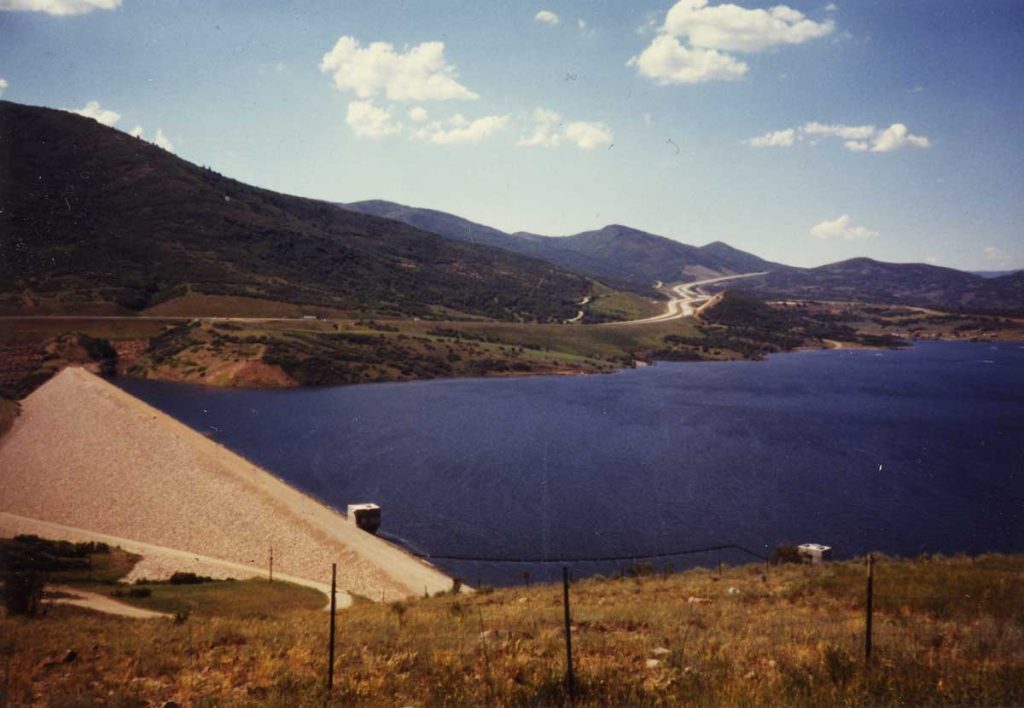
Credit: Park City Historical Society & Museum, Terry Meury Collection
Residents of Wasatch and Summit Counties mobilized to prevent the CUP from raising the Deer Creek Dam. An editorial in The Wasatch Wave dramatically warned readers that this scheme “would spell doom for our County,” as the now-expanded reservoir would displace almost one hundred people and potentially immerse the nearby rail line.[vi] Locals enlisted the aid of Governor George Clyde, as well as Wallace Bennet, longtime representative of Utah in the U.S. Senate, who questioned whether the expanded Deer Creek Reservoir would even provide enough water to obviate the building of an entirely new dam elsewhere along the Provo River.[vii]
The backlash prompted the CUP to consider an alternative project; in 1963, they began studying the viability of constructing a new dam north of Heber, which they called the Jordanelle. It was quickly determined that not only would the construction of the Jordanelle Dam provide all the water needed for the area, but that it would be cheaper than the alternative proposals considered by the CUP; Charleston was saved.[viii] The Deseret News lauded the inhabitants of Heber Valley for their successful push to stop the Deer Creek Reservoir project, and proclaimed that the incident “shows that it pays to fight for what you believe.”[ix]
The Jordanelle Dam proposal, however, would not be entirely free of controversy. The dam’s potential environmental impact, cost, and structural integrity would all be hotly debated, by locals and experts alike. Plus, while Charleston may have been spared a watery grave, this new project threatened to sink the small town of Keetley beneath the water of the Wasatch Back’s newest reservoir. Those stories will be told at a later date.
The Park City Museum is hosting several lectures this fall. Find the details on our website: https://parkcityhistory.org/events/
[i] “History,” Rockport State Park, Utah State Parks, accessed July 26, 2025, https://stateparks.utah.gov/parks/rockport/history/#:~:text=Between%201954%20and%201957%2C%20the,and%20Rockport%20Reservoir%20was%20created.
[ii] “The Central Utah Project – An Overview,” U.S. Department of the Interior, accessed July 25, 2025, https://www.doi.gov/cupcao/Overview.
[iii] “Series to Explain Impact Of Central Utah Project,” Garfield County News, June 5, 1975, https://newspapers.lib.utah.edu/ark:/87278/s68s5m99/3384574.
[iv] “New Reservoir Proposed; Compromise For Storage in Wasatch County Area,” The Daily Herald, February 27, 1963, https://newspapers.lib.utah.edu/ark:/87278/s6md3f8b/23813976.
[v] “You Can Fight ‘City Hall,’” Deseret News, March 2, 1963, https://newspapers.lib.utah.edu/ark:/87278/s6pw1hh0/25390174.
[vi] “Time to Insist on Our Rights!” The Wasatch Wave, March 21, 1963, https://newspapers.lib.utah.edu/ark:/87278/s6b6189d/24666284.
[vii] “Bureau of Reclamation Favors Jordanelle Reservoir, Senator Told,” Valley View News, April 18, 1963.
[viii] Ibid.
[ix] “You Can Fight.”