The Glenwood Cemetery has been called Park City’s storybook, and with good reason. The story of each person buried there is a chapter in the history of our town. As you stroll through the Glenwood today, the cemetery is beautifully maintained, both as an historic cemetery and a wildflower sanctuary.
But it wasn’t always that way. There was a time when the Glenwood lay in total disrepair. Headstones were knocked from their bases, overgrown vegetation covered many of the gravesites, and litter was strewn everywhere. Restoration and preservation efforts in recent years have saved the Glenwood. In order to know our history, it is critical that we preserve our cemeteries.
The Glenwood was established in 1885 by a coalition of Park City’s fraternal organizations at a time when the city’s mining industry was flourishing. These fraternal organizations formed the Glenwood Cemetery Association with a board of directors who orchestrated the original creation and planned for future maintenance. Each lodge contributed $25 annually as an assessment fee and an occasional additional amount for improvements. For the next forty years, the Glenwood was properly cared for under the guidance of the association.
Then in May 1925, the Park Record carried an article titled “Out of Funds,” describing the financial situation of the Glenwood Cemetery Association and informing readers that the usual Decoration Day cleanup would not be done. Essentially, the association was unable to collect the funds from the remaining fraternal organizations to properly care for the cemetery. As the price of silver dropped, mining in Park City had slowed down and people were leaving town. All the fraternal organizations, except the Elks, soon abandoned their Park City chapters, leaving no one to continue to take care of the Glenwood Cemetery.
In 1928 the Park Record described the conditions of the Glenwood as “woefully neglected, a disgrace to the community” and announced that the Elks had formed a committee to look at ways to make the cemetery more presentable by repairing the broken-down fences and hauling away accumulated trash. The committee enlisted the help of the Boy Scouts and concerned citizens to make the Glenwood as presentable as possible for Memorial Day.
In 1931 the discouraged Glenwood Association asked the City Council to take over control and supervision of the cemetery, but the City would only agree to keep the road open and arrange for a sexton to dig graves for a fee. Meanwhile, the Boy Scouts continued with their clean-up tasks every Memorial Day.
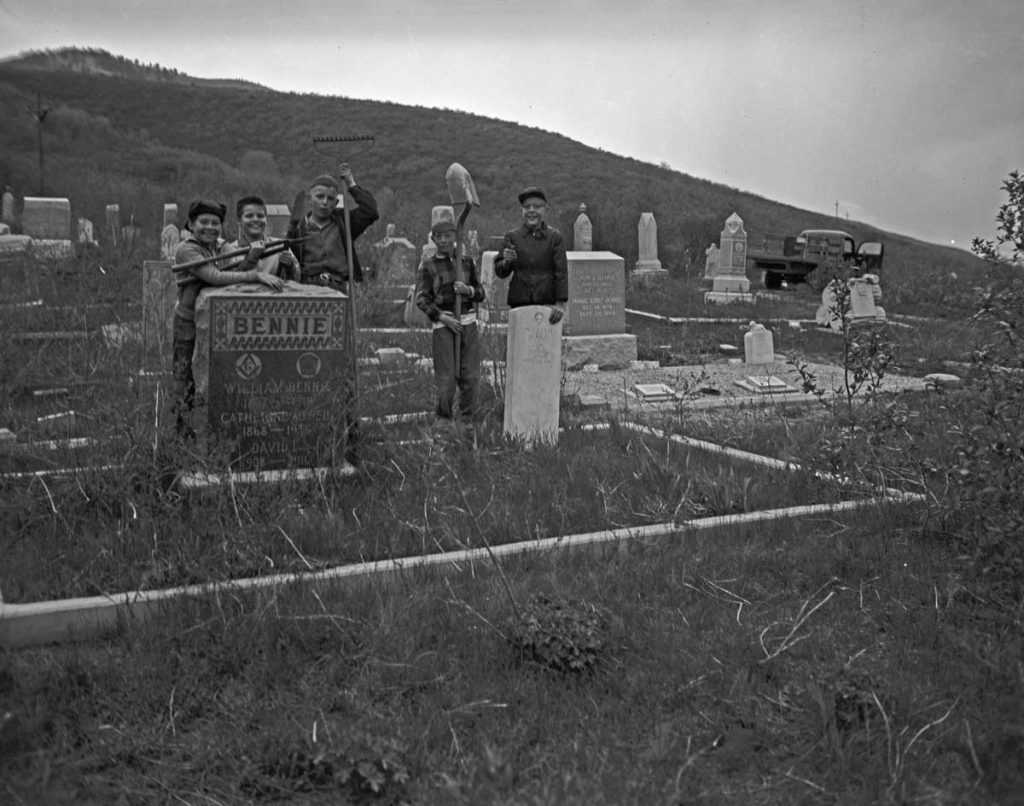
Credit: Park City Historical Society & Museum, Kendall Webb Collection
During the 1930s considerable work was done at the Glenwood by some of the original fraternal organizations – Masons, Elks, Moose and Odd Fellows – with help from the federal Civil Works Administration. In 1946 the Glenwood Association once again asked the City to take over the maintenance of the cemetery. Again, they declined. It appears that the association disbanded soon after that, leaving no one remaining to care for the Glenwood Cemetery.
For the next forty years the Glenwood was neglected and seriously vandalized. By 1976 it was almost unrecognizable as the sacred burial place for more than 900 Park City miners. The Elks got involved once again under the leadership of Mel Fletcher and started the preservation ball rolling. Mel described the work effort as “clearing the wild growth of weeds, trees, and vines.”Mel hoped to see the cemetery brought back to being a lovely area.
The developing Park City Historical Society began to show an interest with a tour of the cemetery on Heritage Day in May 1976. Soon the Historical Society, with assistance from Saint Mary’s Catholic Church, the Hibernian Society, and the Elks Lodge, organized Glenwood clean up days and a fund-raising campaign, resulting in the re-establishment of the Glenwood Cemetery Association. The volunteer committee continued improvements and received several awards for its preservation and stewardship efforts.
Since 2016, the Glenwood Cemetery, a designated National Historic Place, has been owned by the Park City Historical Society & Museum. The Glenwood Committee of the Museum Board of Trustees exists with the purpose of protecting, preserving, and fostering appreciation for the Glenwood.
For several summers now, we have contracted with the nation’s foremost expert in cemetery preservation to right, repair, and restore the headstones and markers that are most damaged. To date more than 200 stones have been preserved and set in the ground in a safe and ideal manner. In addition to the headstones, many of the stone copings that surround individual plots have also been dug out and reset at their original level.
Not only are we providing attention to what our visitors can see above ground, we are also focused on what’s unseen below ground. We have worked with a heritage consultant to conduct ground-penetrating radar in several key areas within the cemetery looking for potential burials. So far, we have discovered more than 50 potential burials that are unmarked with no aboveground stones visible – a huge revelation! Each of these locations has been GPS-tagged; One of our future plans is to indicate each location with an above ground marker signifying the potential burial below.
Today, thanks to grants and donations from residents and visitors, funds exist to maintain the cemetery’s five acres, stabilize and repair broken headstones, and plan for improvements. Plans include fresh gravel on the roads, interpretive signs, removal of dead trees and noxious weeds, and special events to promote public interest and education, in addition to the continuing work mentioned above.
Through preservation efforts, the Glenwood Cemetery will remain as a historic Victorian cemetery and continue to tell the stories of the people who created Park City.
The Park City Museum is hosting a lecture titled “Preserving Utah’s Cemeteries” given by USHPO Utah Cemeteries Program Manager Amy Barry on Wednesday, May 21 from 5-6 p.m. at the Museum’s Education and Collections Center located at 2079 Sidewinder Drive.