This is the second article in a periodic series discussing one of the single most significant excavation projects in the Park City area – the construction of the Snake Creek Drain Tunnel.
In our first chapter, we discussed the establishment of the Daly-Judge Mine, their ambitious plans, and the pressing need to de-water their subterranean holdings. Failure to do so threatened their continued prosperity.
In March 1910 salvation beckoned with the formation of the Snake Creek Mining and Tunnel Company. The General Manager (GM) of the Daly-Judge, G.W. Lambourne would also serve as the GM of the new entity. His managerial demeanor was described as “demanding.” His oft repeated motto, “we must have results,” was known to all under his reign. Fortunately, the Daly Judge’s available cash – $750K (about $25 million in 2025) – attracted employees with exceptional talent.
The company purchased 750 acres of patented mineral land. Also, they bought another 320 acres five miles west of Midway. This location, at the junction of Snake Creek and Wolverine Canyons, would be the staging area for their tunnel project. No question this was going to be a large project, but the acreage provided ample space for expansion. Their ultimate plans envisioned the construction of a smelter, a reservoir, and eventually a new town. Work commenced in May 1910.
O.N. Friendly, a gifted engineer, enjoyed an enviable reputation in western mining communities – Park City included. He exuded confidence. Like other distinguished engineers of the era, Mr. Friendly believed firmly that the application of scientific discipline could surmount even the most difficult of challenges. This at a time when folks embraced the concept of an “unsinkable” ship. That bubble burst on April 15, 1912 when the Titanic descended to the ocean floor.
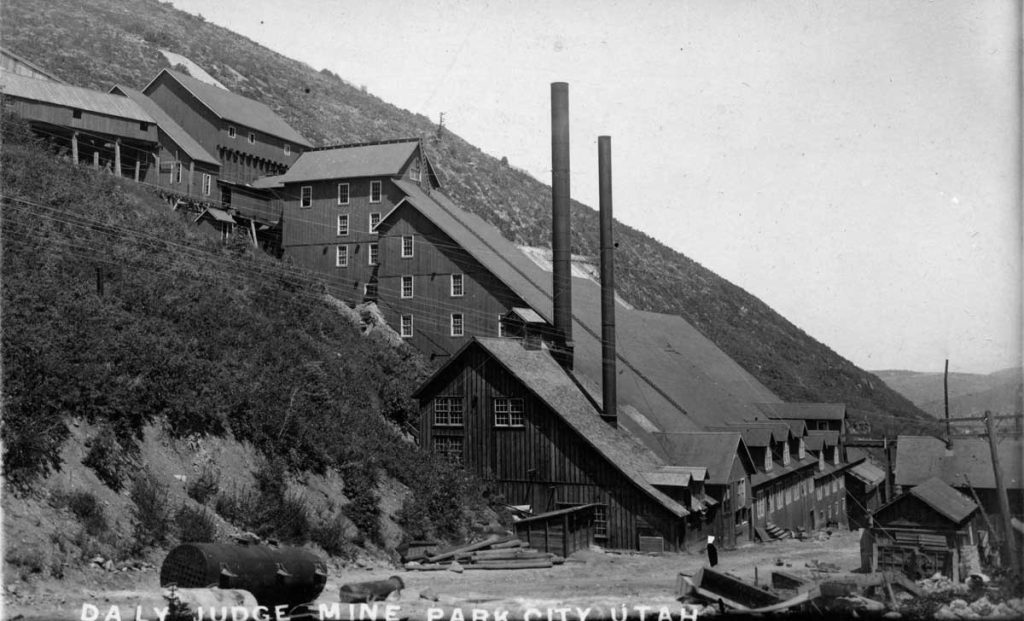
Credit: Park City Historical Society & Museum, Mel Fletcher Collection
Mr. Lambourne appreciated that delivering results depended upon employing the “best and brightest.” Thus, Mr. Friendly received an offer he could not refuse. He was hired as the lead engineer for the tunnel company. His plan: construct a double-track bore of 14,500 feet (2.75 miles) to access the underground riches of the Daly-Judge Mine. The tunnel would be eight feet six inches wide, six feet six inches in height (above the rail line), with a water channel four feet by four feet below the tracks. The two tracks would significantly increase productivity. A boardwalk would also be constructed to further enhance worker performance.
Excavation started in Snake Creek Canyon at an altitude of 6,932 feet. At its deepest point, the bore would be 3,730 feet below ground. The challenges increased the deeper the crews excavated and it was a dangerous working environment – one that all generations of miners know well.
For six years, sixty men worked full time on the project. A small town evolved in close proximity to the tunnel: Boarding houses, bunk houses, extensive machine shops (complete with carpentry and blacksmith facilities), a power plant, staging and storage buildings, etc. For the workers, no comfort was spared: electric lights, telephone service, hot and cold water, and shower baths. Mr. Lambourne wanted a comfortable and highly motivated workforce.
The project was fully funded, employed the best of the best, embraced the most advanced technology, and offered high-quality living conditions. What could possibly go wrong? Our next Chapter will cover the ensuing calamities.
The author is indebted to the contributions of Steve Leatham and Clark Martinez for this series of articles.
The Park City Museum is hosting lectures on four of the next five Wednesdays. Read about each one here: https://parkcityhistory.org/events/.