This is the fourth article in a periodic series discussing one of the single most significant excavation projects in the Park City area – the construction of the Snake Creek Drain Tunnel.
As a reminder, the third article detailed the first collapse during construction that occurred at a tunnel depth of 4,066 feet on February 5, 1912. To remedy the “heavy ground,” workers installed the strongest timbers available, 10’ x 10’ Oregon pine, which failed in less than 24 hours. The situation demanded installation of Mr. Friendly’s innovative but very expensive steel reinforced concrete lining. The liner held. His next monthly report was brief and optimistic, conveying a business-as-usual tone. For those toiling below ground, the situation was anything but “usual.”
Workers voiced their concerns regarding the increasingly dangerous conditions. They recommended that each section be braced with full tunnel sets and heavily lagged. Should those fail, the concrete lining was necessary. Management disagreed; they balked at spending the money.
Unfortunately for the workers, tragedy arrived at the end of July 1912 when another collapse proved fatal. Twenty workers walked off the job due to the unsafe conditions. Mr. Friendly’s associated report simply referenced an “accident” and that work was suspended for five days. He lamented the contractor’s inability to procure enough workers to support two shifts. The Snake Creek Drain Tunnel was acquiring an ominous reputation – one which would prove indelible.
Labor problems and unstable ground persisted. Correspondence noted that crews were not fully compensated for work performed in October 1912. And this was not the first time. Even more outrageous, the proprietor of the laborers’ boarding house, Mrs. Ellen Hancock, had also been stiffed. The aggrieved parties requested that Mr. Friendly pay them directly in full before continuing work. He was anxious to do so, explaining (to management) that delays in completing back work were “dangerous” to the tunnel. Without the required bracing, the bore was prone to “rapid” closing, the result of “swelling” ground. Eventually, the money issues were resolved, and so excavation resumed.
Construction of the tunnel took six years, from 1910 to 1916. Different contractors were employed, most notably Free & Taylor, McIIwee, and The Mid-West Tunnel Company. For workers, danger increased the deeper they penetrated the mountain. Beyond 3,200 feet (reached on May 2, 1911) the prospect of “bad ground,” dead air, raging water, equipment failures, and death were daily worries.
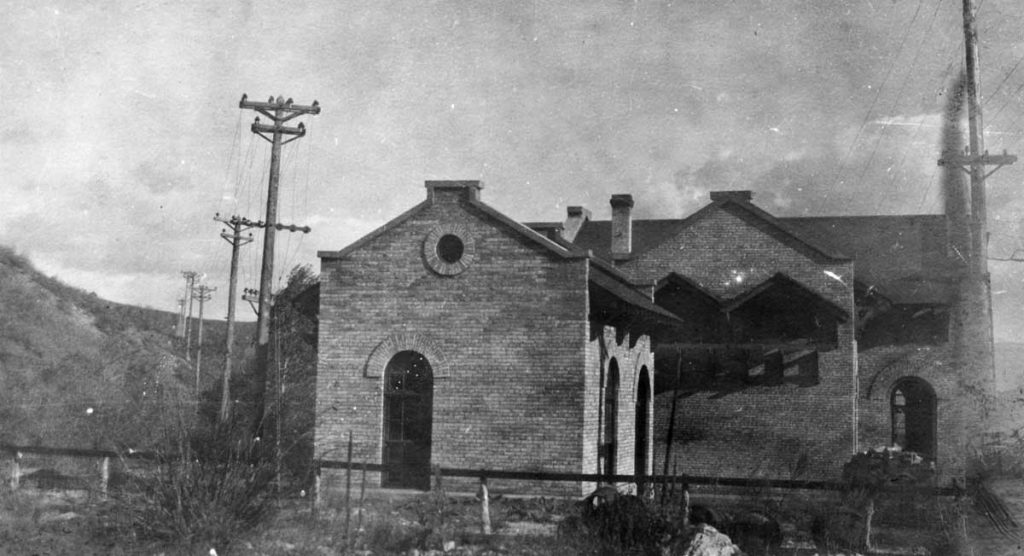
Courtesy of the J. Willard Marriott Library, Rocky Mountain Power Company Photograph Collection
On March 30, 1916, the Snake Creek Drain Tunnel reached its end: 14,499.7 feet. While designed to accommodate two tracks, only one was installed. Regrettably, there was no need for the second one. For financiers of this endeavor, economic justification depended primarily on accessing vast new ore reserves, monetizing the water, and the tunnel’s structural integrity.
As it relates to discovering valuable mineral reserves, ore samples taken at tunnel depths of 7,581; 9,700; 10,193; and 14,280 feet were conclusive – there was no commercial potential. Mr. McKay noted, at Mr. Friendly’s request, that water now represented the most valuable output of the tunnel.
And there was water to spare. The maximum tunnel flow, recorded in October 1922, was 14.54 C.F.S. – 7,000 gallons. However, ownership of the water rights remained unresolved. The resolution initiated a protracted legal engagement destined to reach the U.S. Supreme Court. Their 1923 decision was regretful for the tunnel builders. The lack of commercial ore reserves combined with the failure to secure water rights delivered financial heartbreak to Friendly and friends.
This series will be continued.
The author is indebted to Steve Leatham and Clark Martinez for their contributions and patience to generously address my copious questions.
Happy Hanukkah from the Park City Museum!