This is the fifth article in a periodic series discussing one of the single most significant excavation projects in the Park City area – the construction of the Snake Creek Drain Tunnel.
Conceived in 1910, the Snake Creek drain tunnel project was ambitious. Investors and tunnel architects dreamed big. Phase 1: construct a double track 2.75 mile bore to access Park City’s Daly-Judge Mine (one of the wealthiest mining companies in the district). In Phase 2, the builders envisioned extending the tunnel another two miles to access the mineral riches of Big and Little Cottonwood canyons.
For Phase 1, the project’s economic success depended on developing new ore reserves, dewatering Park City’s mines (especially the Daly-Judge), and monetizing that water. By 1916 investors realized that a “bonanza” associated with virgin ore reserves was not to be. There were none.
At least their precious liquid asset could be sold for both power generation and irrigation. For the Daly-Judge’s Board of Directors, there was no doubt who owned the water rights. The Midway Irrigation Company (established in 1887) believed otherwise. Resolving who owned the water ignited a legal firestorm. It burned for seven years.
The flames subsided in 1923 when the U.S. Supreme Court ruled in favor of the Midway Irrigation Company. The 7,000 gallons per minute gushing from the drain tunnel did not, by rule, belong to the Daly-Judge or its partner in the Snake Creek Mining and Tunnel Company. The financial impact was immediate. Dreams of a healthy return on investment were shattered. Their engineering marvel proved to be a fool’s errand.
What else could possibly go wrong?
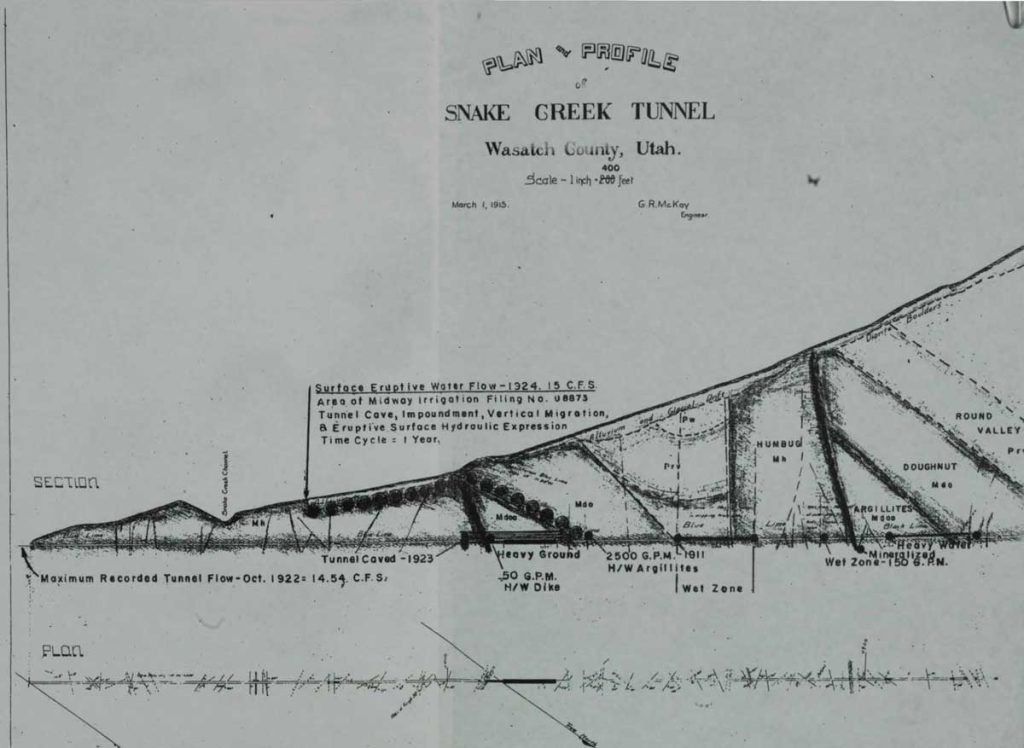
In 1923, at approximately 2,500 feet from the portal, the tunnel experienced a catastrophic cave in. Think of pinching a paper straw with your fingers. The tunnel was sealed shut. No longer able to exit, the raging water sought escape. It followed a vertical fissure 300 feet to the surface. The resulting energy created a crater – violently so. This event was described as an “Eruptive Surface Hydraulic Expression.” The water flowed for years. Eventually the energy dissipated and the torrent ceased. The Midway Irrigation Company was perplexed: where did the water go?
Credit: Courtesy of the Marriott Library.
The drain tunnel debacle combined with a cascade of other regretful circumstances placed the Daly-Judge mine in harm’s way. In June 1925 their assets were acquired by the Park Utah Mining Company, their compromised bore a testament to what might have been. As it related to the tunnel, calamity returned when three adventuresome, yet foolish friends decided to tempt fate and entered the abandoned tunnel. In advance of the caved-in location a dead air zone awaited. Miraculously, they escaped death. For locals, this incident reaffirmed the tunnel’s inherent malevolence. Enough was enough. The portal was buried and would remain so for 60 years.
While the subterranean infrastructure entered a prolonged period of repose, the same could not be said for the areas served by the Midway Irrigation Company. Residential, recreational, and agricultural expansion combined with climate change triggered ever increasing demands for water. These trends promised to accelerate. In an attempt to satiate this unrelenting thirst, in 2003 the company embarked on a mission to reopen the Snake Creek Drain Tunnel. They sought their long-ago buried treasure: water. Their quest would consume eleven years.
Our next and final installment in this nonconsecutive series discusses the ensuing treasure hunt, the dangers encountered, and the bravery of those who dared to challenge the mountain yet again.
The author is indebted to Steve Leatham and Clark Martinez for their invaluable contributions to this series.
The Park City Museum will reopen to the public on Friday, January 30.