Park City was home to two opera houses in the late 1800s. The first was Society Hall, later known as the Park Opera House, located in the Society Building at 354 Main Street. Construction of the public building and hall, also planned for use by the “secret societies,” was accelerated by a forthcoming meeting of the Grand Lodge of Odd Fellows of Utah, scheduled for April 1884 in Park City.
The Society Building was incorporated and funded as a public building. Society Hall held its first event – a society ball – on Thanksgiving Day 1883, even before the plastering was in place. The hall was officially ready for occupancy when it held a New Year’s Eve ball the following month. In the ensuing years, the hall hosted a wide variety of community events including dances, masquerade balls, live theater, and holiday celebrations.
A second opera house was envisioned years before it materialized. In the early 1890s, developers sought stock solicitations to finance the construction of a project that would include an opera house and a hotel. Although those efforts never came to fruition, interest in a new opera house was intensified when fire damaged the Society Building in March 1896.
The fire started in the adjacent Mantor Building, which was destroyed, and the hall – by now known as the Park Opera House – sustained fire and water damage. Fortunately, firemen were ultimately able to save the structure. The Park Record reported on the efforts of one such fireman, stating that “while combatting the flames in the attic of the opera house [he] thoughtlessly set his lantern upon a live wire and was rudely shocked for his action. He will avoid live things in the future.”
Following the fire, three local lodges of the Ancient Order of United Workmen (AOUW) announced plans to develop a joint lodge room and modern opera house and signaled they were motivated to act, with or without cooperation: “Our people realize the need of such a building and if the owners of the [current] opera house do not fall in with the present progressive idea such a structure will be built anyhow during the coming summer on the site now occupied by the livery barn opposite city hall.”
In April 1896 efforts to consolidate interests seemed optimistic: “All in all the indications are extremely favorable that the present agitation will result in the erection of a magnificent building especially as a number of citizens who have plenty of the wherewithal stand ready to subscribe for liberal blocks of stock as soon as the books are thrown open.”
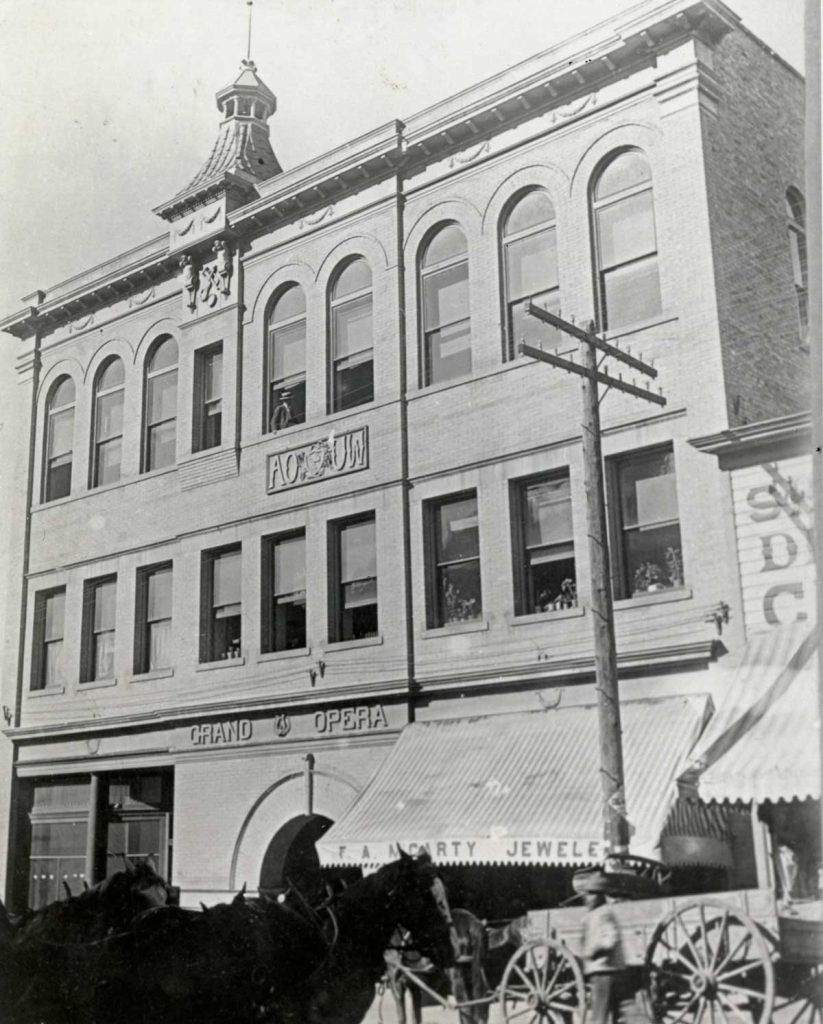
Credit: Park City Historical Society & Museum, Leland Jerome Paxton Collection
The cooperative spirit captured in April must have dissipated soon thereafter; the AOUW pressed forward independently with their new Grand Opera House project, purchasing land the following June. Meanwhile, the Park Opera embarked on renovations, with improvements including the construction of a larger dance floor, modernization of the facility, and new theater chairs.
The Grand Opera House, finally erected and considered to be one of the finest buildings ever built in Park City, hosted its first public event March 1898. Just three months later, Park City’s Great Fire of 1898 destroyed both opera houses. The infant Grand Opera House, valued at $50,000, was woefully underinsured and the policy had lapsed, making it one of the costliest losses of the Great Fire.
The fraternal orders pledged to rebuild; The paper reported: “The trustees of the different secret organizations of the city got together Wednesday evening and took the preliminary steps looking to the erection of a new opera house and lodge room building. That such a building will be erected there is no doubt as the dozen or more lodges of the city must have a place to meet. Let the good work go on.”
In time, the fraternal orders’ interest in the project waned, and although they and others announced plans to construct new opera houses, none were built. In 1899, live theater was restored to Park City when the Dewey Theatre opened as the town’s new cultural center.
The Park City Museum is hosting a lecture titled, “The Opera in Utah,” given by composer and conductor Benjamin Beckman, Artistic Director of Park City Opera, on Wednesday, August 13 from 5 to 6 p.m. at the Museum’s Education and Collections Center located at 2079 Sidewinder Drive. It is free and open to the public.