They say early development is important for one’s success in life. All children in the U.S. are schooled starting at about age 5 and continue until about 18. A college education may then be followed. All this is to help the child become successful later. It’s widely accepted that a stable home environment with caring parents is important for a child’s cognitive growth and moral and cultural values. Early employment experience is also known to influence one’s attitudes about integrity and ethical behavior in the workplace.
With that background let’s see how we would assess John Joseph Daly’s prospects based on his early years. He was born in 1853 in Morris, Illinois – population 500 to 1,000. His father died when John was 8 years old and he was orphaned at age 10 when his mother passed. A few years later he took a job as a Missouri River steamboat cabin boy. He had two years of schooling before he left home. Perhaps we can agree his early childhood development appears sketchy at best.
Fort Benton, Montana is 2,300 miles upriver from St. Louis, where John had likely joined his riverboat. It was a 2-to-3-month journey upriver to get to Fort Benton, where John landed in 1867 when he was 14 years old. At the time, Fort Benton had a population of around 500 and was one of the most remote river ports in the country. It was a rugged frontier boomtown; a gateway for prospectors to the gold fields in Montana and a thriving center for trade with the Native tribes. It was known for its itinerant population of prospectors, gamblers, and “adventurers” moving through town. Its general lawlessness, saloons, and presence of abundant gold led to its reputation as, “the toughest town in the northwest.” So, not the best place for John as a lone child.
John reportedly worked for a couple of Indian traders. Indian traders were authorized by the U.S. government to trade manufactured goods for Native products. They lived near tribal lands, usually in isolated locations where they had little legal oversight. There are documented examples of unethical or exploitive Indian traders; Problems included noncompliance with the rules and license requirements and even smuggling contraband to Indian recipients. Reportedly, one of his trader bosses treated John quite harshly and another kindly. So, he probably observed both bad and good examples of trading (and adult) behavior.
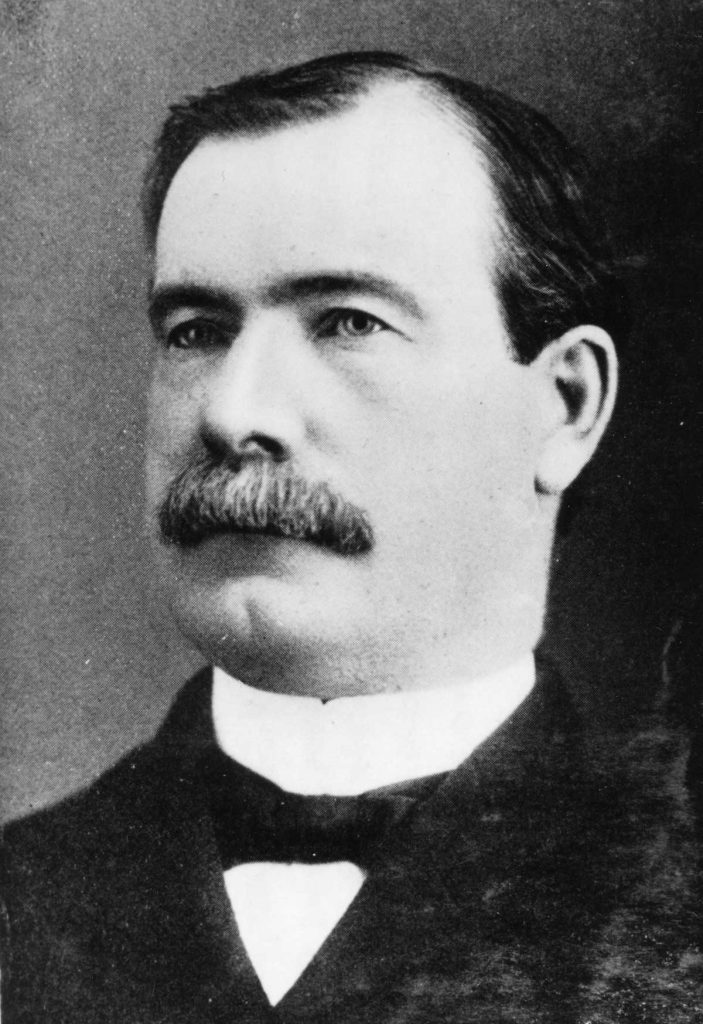
Credit: Park City Historical Society & Museum, Himes-Buck Digital Collection
In Montana, he learned about prospecting and mining. Prospectors were hardy, individualistic, and usually close to being broke. What drove them to endure all sorts of hardships was their universal ambition to get rich quick. They learned to be opportunistic salesmen with sometimes “imaginative” descriptions of the value of their prospects – and some were just conmen practiced in “salting” their claims (literally sprinkling valuable material near the entrance of a claim or mine to fool investors into buying). We can assume young John may have experienced both types of prospectors.
In 1869, when he was 16, John traveled over 600 miles from Fort Benton to the White Pine mining district in Nevada, which was undergoing a silver boom. He arrived at the peak of the silver production associated with the dramatic success of many mines and mills. There were four boomtowns in the district. He might have lived in Hamilton, the largest, with a population of about 12,000. There, he would have been exposed to a thriving city with multiple newspapers, theaters, hotels, banks, churches, stores, and saloons. This was likely an intense time for John to learn about mining and milling silver ores and to experience the diverse businesses associated with mining.
The White Pine mining boom dropped sharply after 1870 and businesses began to wane. It’s no surprise, then, that John visited Utah in 1873 to try prospecting. He joined a wave of other prospectors flocking to Utah after ore discoveries in the Wasatch and Oquirrh mountains. That same year, a fire destroyed most of Hamilton’s business district, which accelerated the outmigration and economic collapse of the White Pine mining district. So, after a potential crash course in mining and business in Nevada, 23-year-old John J. Daly migrated to Salt Lake City in 1876. Perhaps by then he overcame his childhood formation and arrived a wiser and budding mining entrepreneur ready to make something of himself.
John J. Daly went on to become a famous mining baron in Park City. Learn the rest of his story at a free lecture by Brian Buck on December 3 at 5 p.m. at the Park City Museum’s Education Collection Center, located at 2079 Sidewinder Drive.