Park City’s flourishment as a mining community depended on the extent and quality of its mineral treasures and railroad access to local, regional, and national markets. Union Pacific (UP) was the first railroad to reach the fledgling mining camp, doing so in 1880. They constructed a standard gauge (4 feet 8.5 inches), 27-mile spur from Echo, about 30 miles north of town. Railroad personnel referred to the spur as the “Park City Main.” UP served nine different communities on this line – not including spurs to various businesses.
In 1889 the Salt Lake and Eastern Railroad constructed a narrow-gauge line (3 feet) from Sugar House to Park City, providing a direct connection to Salt Lake City. Unfortunately, cost overruns placed the company in a precarious financial situation. The Denver, Rio Grande and Western Railroad (DR&G) pounced on the opportunity, acquiring the bankrupted local company in 1890. They would spend the next three years re-laying the line to make it standard gauge – at considerable expense. Remnants of this route remain today in Parley’s Canyon. DR&G abandoned their Park City branch in 1947, ending 58 years of service.
Circa 1965 to 1986 business on the UP route was robust – but with two significant caveats. First, the railroad’s traditional customers, the town’s mines, were in their twilight years as it related to mineral extraction. In April 1982 the last remaining mining company conducting business in PC, Canadian conglomerate Noranda, abruptly terminated operations. After 114 years, Park City’s remarkable run as a mining town ended. Over the next few years attempts to revive mining proved for naught. Not to worry, the town’s economy was now powered by “The Greatest Snow on Earth”.
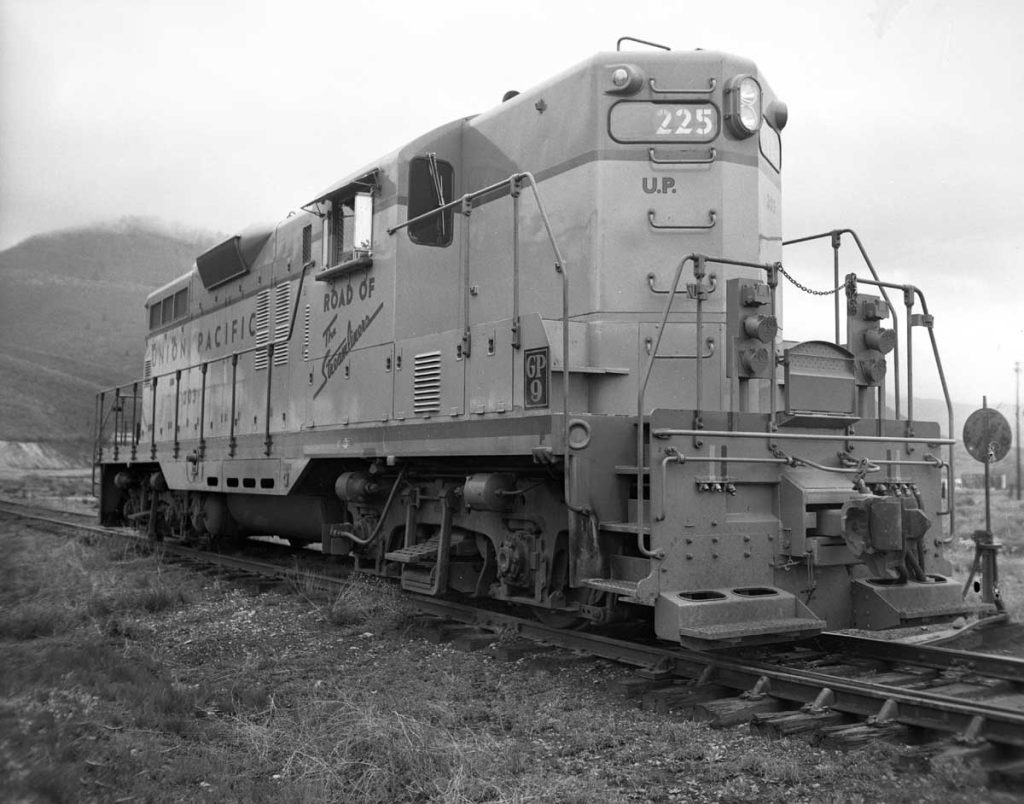
Credit: Park City Historical Society & Museum, Kendall Webb Collection
The second caveat – during this time 90% of UP’s business came from one customer, Chevron Chemical Corporation’s phosphate reloading facility at Phoston (near where Builders First Source is located today). Evidence of the former railroad infrastructure is clearly visible from Richardson Flat Road as one looks southwest. Loss of Chevron as a customer would trigger an end-of-the-line event.
Bad news arrived in Q1 1986. Chevron announced their plan to open a new phosphate processing facility near Rock Springs WY. They would do so before summer’s end, making the Phoston plant obsolete. Faced with the loss of Chevron’s business, UP broadcast their desire to sell the branch to a qualified buyer or abandon it altogether. The purchase included the right of way (encompassing 400 acres) and 30 miles of track. Surprisingly, UP’s Park City depot was not included. The asking price in 1986 was $1.7M (approximately $8.7M today).
Summit County, Wasatch County, and Utah County expressed their collective interest in purchasing the line. In pursuit of this goal, the three counties formed the Tri-County Rail Commission. Wasatch County Commissioner Pete Coleman was named Chairman of the newly formed entity. Thirty thousand dollars was approved for a feasibility study. UDOT would play a key role as well. The Commission envisioned creating a mixed-use (tourist and industrial) railroad totaling 67 miles. Their preliminary name for the new enterprise: The Tri-County Railroad.
They intended to preserve the Park City branch, build an eleven-mile extension to connect with the state-owned Heber Creeper, and serve Sundance with a possible connection to Provo. Senator Orin Hatch and other influential Utah politicians endorsed the concept.
Stay tuned for our article exploring the financial, political, and business challenges to fund the new entity and its ultimate resolution.
Acknowledgements: The author is indebted to the generous contributions of Merill Bryan (UP CIO retired), Marianne Cone, Craig Drury (Heber Valley RR), Sally Elliot, Kerri Gee, Jennifer Harrington, Craig Lacey (Heber Valley RR), Steve Leatham, Clark Martinez, Sandra Morrison, Rory Murphy, Brad Olch, Myles Rademan, and the Union Pacific Historical Society.