Like other women dotted across the American West, Park City women made their way in the world through hard work and grit. While they weren’t toiling in the mines like the men, they were doing an abundance of other things and using a variety of skills to help the town grow and thrive. Ultimately, women’s work helped build Park City – and the West – by making men’s lives easier and their achievements possible.
When Park City was first settled, women contributed to the camp by washing laundry, cooking hot meals, and keeping boarding houses. Women’s domestic skillsets meant that men could spend their days mining and starting businesses—finding their fortune and glory. But, women didn’t simply use their domestic skills inside their homes, many of them ventured past their doorstep and into the community, taking on roles that helped turn the small mining camp into an actual town.
Organizations such as the Women’s Athenaeum Club, founded in 1897, brought likeminded women together to educate themselves and contribute to issues important to the community. The group went on to found the first public library in Park City and advocated for things such as child labor laws and safe milk to drink. In this way, women in Park City were similar to others in settlements throughout the West who used their environment’s forward-looking ideals to venture into the public sphere while turning the “Wild West” into respectable communities with a moral code.
However, it wasn’t just married women or family members that traveled West. Unmarried women also made the journey, and many found success as sex workers. Park City was no exception, and as early as the 1880s prostitutes made a living in the encampment. Not only did their job help satisfy the “lonely, homesick” men working in the mines, but the flourishing industry also brought in significant money for the city through regular fines or “taxes.” In fact, when one Park City mayor attempted to shut down the row, Madam Rachel Urban talked to the Judge Mine Superintendent who then used his influence over Park City Council to get the row back open. He didn’t want his workers taking time off to travel to Salt Lake City to “take care of business.” While it was a tough life, sex work did make many women a small fortune and allow them unprecedented freedoms.
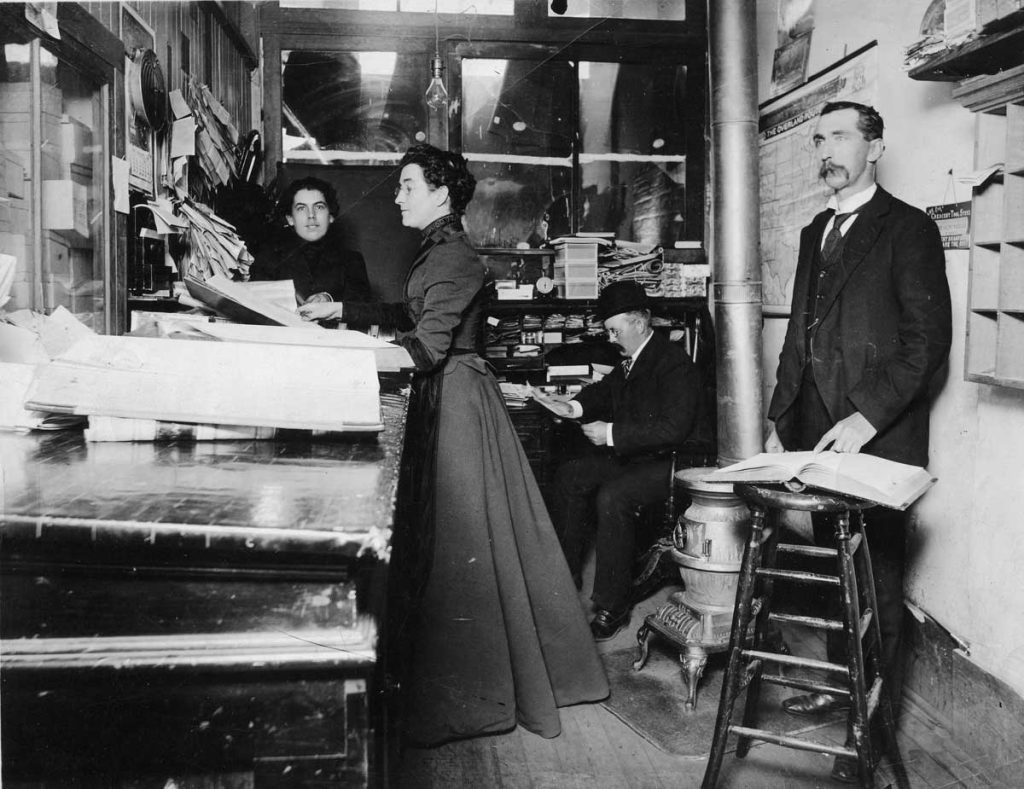
Credit: Park City Historical Society & Museum, Himes-Buck Digital Collection
Some men were reluctant to move West alone because of the amount of work required to survive. Interdependence was a necessity, and people therefore ignored traditional gender divisions of labor. In Park City, women often ran businesses alongside their husbands. One prominent business owner, Ah-Yuen or “China Mary,” ran a China shop with her husband. Their shop catered to Euro-American and Chinese tastes and was probably one of the few places citizens could find unique items that went beyond utilitarian needs. Park City’s Chinatown was likely the second largest in Utah at the time, and Ah-Yuen is one of only a handful of Chinese citizens mentioned in the Park Record.
Another couple, Charles and Carrie Hodgson, moved to Park City and opened a jewelry store. While the couple infamously divorced, Carrie remained in town and ran the popular store for years and was a Main Street staple. Read more about her incredible life here. These and other businesses throughout Old Town helped create a thriving community in the mountains and allowed women to earn a living.
Overall, Park City is a microcosm of the American West and the women who settled it. While men pursued their fortunes underground, women found ways to push the boundaries of Victorian society, shed the ideals they were raised with, and make lives for themselves that their ancestors could only dream of. Not only were they using the skills they were raised with—cooking, cleaning, running a home—but they were expanding the definition of domestic work and entering the public sphere where they created welcoming communities and maintained moral authority.
Still, others pursued freedom by fleeing the confines of a virtuous society and selling their body. And many more joined their husbands and pursued careers of their own. For women, much of this wouldn’t have been possible back East, where Victorian ideals and more stringent laws kept women on the sidelines. For Park City, much of its town life beyond mining wouldn’t have been possible without women.
The Park City Museum is hosting a lecture titled “Zula Nelson: The Life of A Miner’s Wife in Park City, 1937-1952” by mining consultant and former mining professor Mike Nelson on Wednesday, December 10 from 5 to 6 p.m. at their Education and Collections Center located at 2079 Sidewinder Drive.