My name is Ella, and I’m a history-loving Senior at PCHS. The following is the second article in a three-part series on Indigenous Americans in the Park City area for the Park City Museum. The first article summarized early Indigenous activity in Northern Utah, including Paleoindians, the Archaic Period, and the Fremont Culture.
While there has been substantial evidence of Paleoindians, Archaic peoples, and Freemont culture in the region, recent evidence suggests that the Shoshone People sometimes referred to as Numic, arrived in northern Utah, including Summit County 500-700 years ago. In addition, there were three other major groups: the Goshutes (primarily south and west of the Great Salt Lake), the Utes (from the Uinta Basin west as far as Utah Lake), and the Northern Shoshoni (in northeastern Utah, including Summit County).
According to Anthropologist Julian Steward, the “Shoshonean people lived in winter quarters in groups of as many as fifteen families; they then divided into groups in the spring to hunt and forage for food. A common dwelling was a conical lodge thatched with a variety of materials, including rushes and grass. Those of the Northern Shoshoni who had access to buffalo made tipis, using the hides to cover the tipi poles….caves and rock shelters also served as winter dwellings.”
The Shoshone are recognized for their love of and connection to the earth and nature. The Shoshone signal the beginning of their new year with the spring season. With the melting of snow and ice, spring brings an abundance of new life including the new growth of plants and the births of animals. Spring was also the time when the Shoshone people began to travel and look for fresh food.
There is ample evidence of at least seasonal indigenous presence in greater Park City area. Park City appeared to be on the border of the Ute and Shoshone lands, and there is history of both tribes occupying and/or utilizing the area at different times. It appears that the Utes were predominantly west and south (in the Great Basin area), whereas the Shoshone had a more eastern and northern presence in Utah.
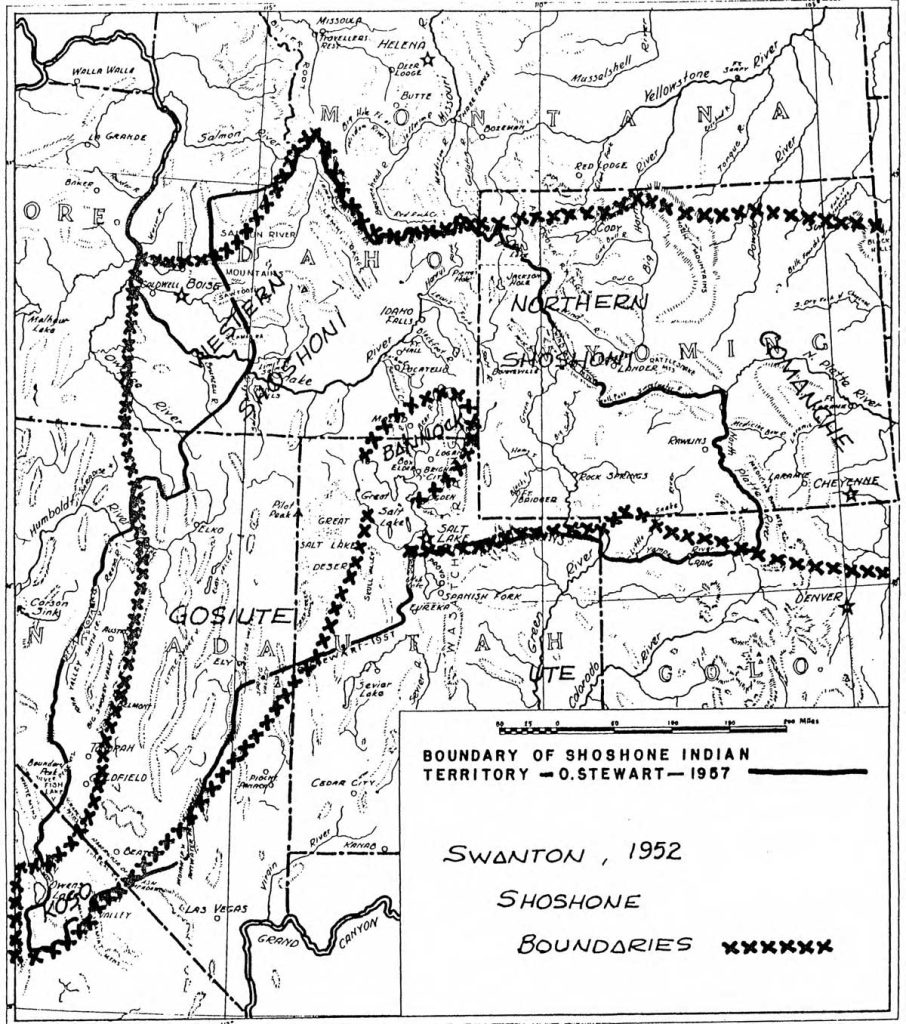
Credit: Courtesy of the University of Utah Marriott Library Digital Library
There is a large and growing body of evidence of pre-settlement Indigenous activity in Summit County. Petroglyphs discovered in northern Summit County, for example, reveal early native presence even at high altitude camps.
Proof of local indigenous presence is woven into our daily life in Utah. In our everyday conversation we use terms rich in Indigenous history. The words “Utah” and its variation “Uintahs” are Indigenous American terms referring to the collective tribes and clans in the Ute Nation, and some know that Wasatch, a word of Ute origin, means “a mountain pass”. Timpanogos, the original name for the Provo River comes from the Shoshone word “Timp-pa-no-quint,” which translates as “water running over rocks.” Just down the road from Park City is the town of Wanship, named after Chief Wanship, a Shoshone chief whose name means “good man.”
In the Snyderville Basin, a local botanist recounts uncovering multiple arrowheads while observing plants. Snyderville has reports of indigenous interactions with white settlers dating back to at least 1850. With numerous oral and written accounts of Indigenous Americans in this area, the arrowheads help verify their presence.
Before the arrival of large numbers of white settlers in the late 1800s, it is clear from Indigenous oral histories that local tribes would at least seasonally travel to the mountainous Park City area for its ample food and natural resources. From a 1928 Utah Historical Quarterly titled “Personal Recollections of Wash-A-Kie, Chief of the Shoshones,” the author writes, “There was at that time a great abundance of game and fish in these mountains, and so was an attractive place for the summer location of these Indians.”
Today’s Park City would come into existence long after most of its local Indigenous history – after white settlers had excluded them from the area through intimidation, violence, or mistrust. There are extensive documented encounters in nearby towns with settlements around the ‘pre-Park City’ area, however.
In a previous Way We Were, we discussed how “early citizens of Peoa and Wanship reported interacting with large parties of Shoshone, sometimes as many as 300 and 400. In the case of these large groups, settlers actually shared food and developed close friendships. White settlers living permanently along the Ute’s seasonal paths also reported positive relationships with the Ute camped along the outskirts of their towns.”
Check back next week for the conclusion of this series on Indigenous peoples in the Park City area.
The Park City Museum is hosting a lecture titled “The Land is Alive: Indigenous Views on Nature,” given by former Chairman of the Northwestern Band of the Shoshone Nation Darren Parry on Wednesday, May 7, from 5-6 p.m. at their Education and Collections Center located at 2079 Sidewinder Drive.