When it comes to the story of Edward Rowan’s life and death, we have only the barest outline with which to work. He lived in Park City for a short time and appears to have passed his days unremarkably. But on a Monday in late June 1893, he walked into the Palace Drug Store and bought a bottle of morphine. Just hours later, he turned up dead in an abandoned passenger car of the Utah Central railroad.
The pieces of this puzzle are limited to a single article in the Park Record. The facts as reported were thus: Rowan worked for both the Union Pacific and Utah Central railroads; he had no relatives in Utah; and on the day he died he got drinks with and borrowed money from W.S. Sharp, who, in addition to being the druggist from whom he bought the morphine, was an acquaintance of Rowan’s from the railroad.
Rowan’s body was found late Monday night by John McNichol. He reported it to W.H. Harris, city Justice of the Peace, who quickly cobbled together some men for a coroner’s jury. They followed McNichol to the site of the rail car which, they discovered upon arrival, was on fire. After pulling Rowan’s body unharmed from the car, Harris conducted an examination.
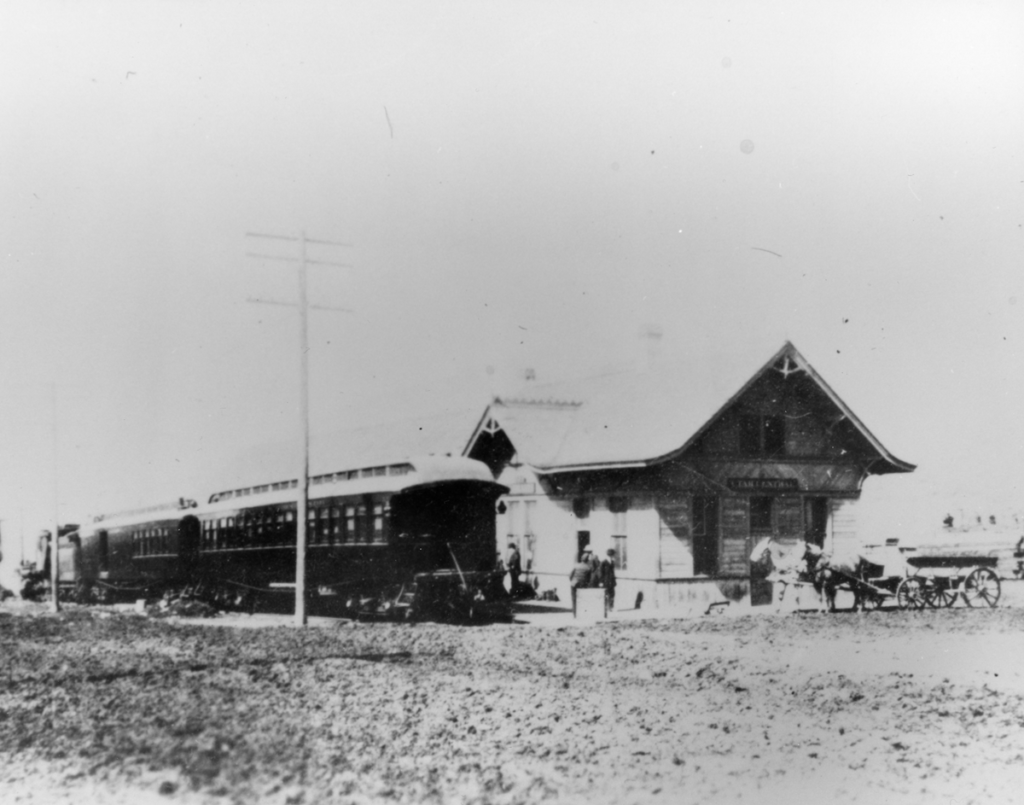
Credit: Park City Historical Society and Museum, Thomas F. Hansen Collection
When he made his initial report, McNichol gave no indication that he’d recognized Rowan. However, his story changed as the case unfolded. During Harris’s examination, McNichol not only identified Rowan, but offered details about his life. At an inquest held Tuesday morning, McNichol admitted he’d started the fire in the train car. Chilled by the cool night air, he said, he’d set a fire in a pit, which is allegedly when he noticed Rowan’s body. After he’d left to report his find, McNichol testified, “some one had replenished the fire with long wood,” and it spread to the rest of the car.
Further testimonies at the inquest filled in more details. McNichol explained that Rowan had recently been “discharged” from his job with the Utah Central railroad and had gone on “a protracted spree.” Two of Sharp’s regular customers testified that nothing was out of the ordinary in Rowan’s morphine purchase at Sharp’s drugstore. Dr. LeCompte testified that a “careful examination” of Rowan’s body indicated the overdose that killed Rowan had been accidental. Harris was satisfied and the inquest was adjourned. Rowan was buried at the county’s expense.
But really: Is there nothing suspicious in McNichol’s actions? The Park Record never explains how McNichol and Rowan knew each other. Why did McNichol originally deny knowing Rowan only to change his tune? Who was the mysterious “some one” who added fuel to the fire in the rail car? Is it possible that McNichol had a hand in Rowan’s death and tried to cover his tracks?
McNichol fades from the historical record after this incident. As far as Harris, LeCompte, and others involved, the case was closed and nothing was amiss. If there was any more to the story, we’ll never know.
Source:
Park Record, June 24, 1893